
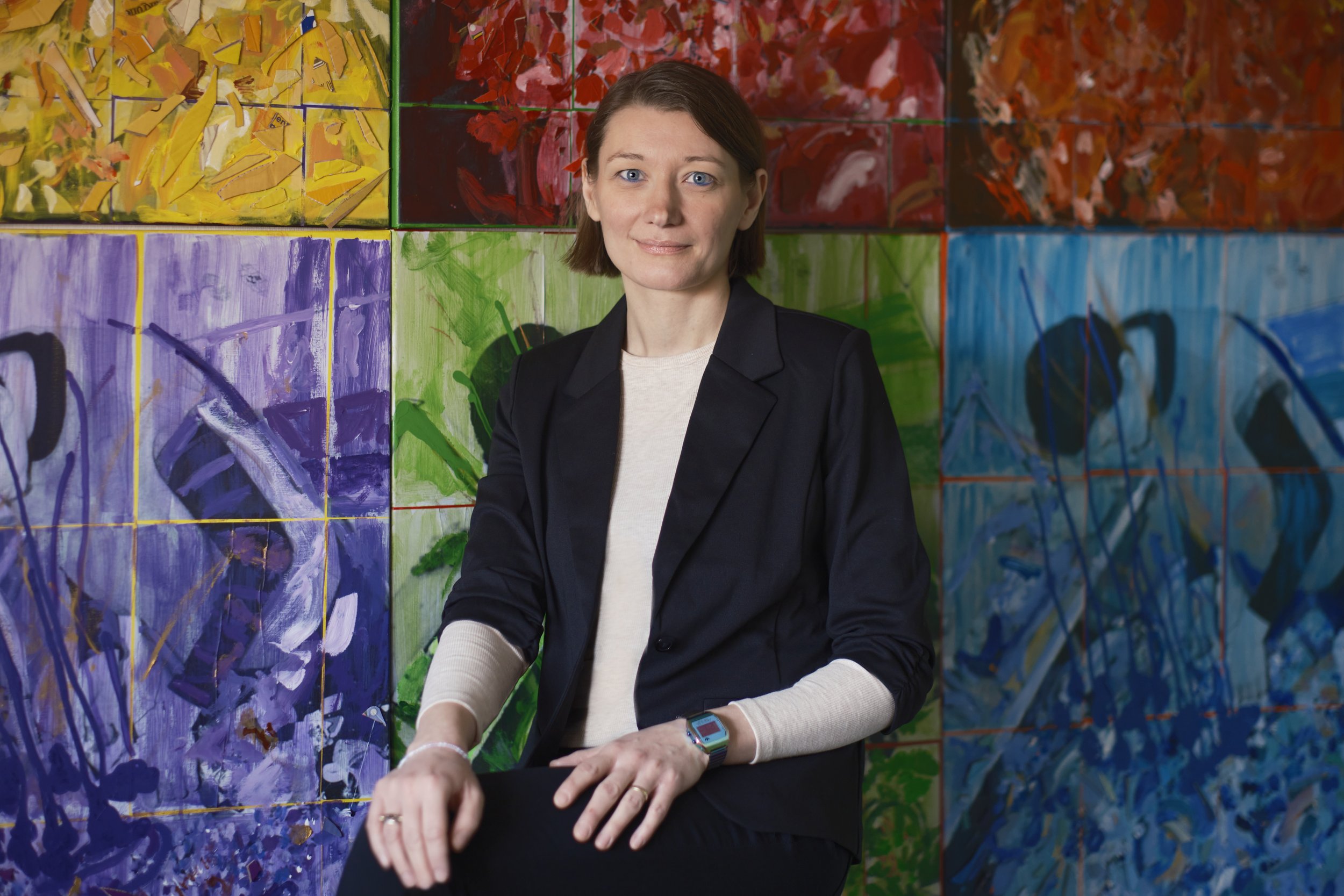
Photo: Davy Denke
Nana RHB is a Danish multidisciplinary artist whose ultra-contemporary practice spans painting, sculptural objects, and spatial installations. Her work is structured around the interrelated concepts of Performativity, Structure, and Color, through which she examines the artistic production of value and the cyclical processes of consumption and reuse.
Central to her practice is the transformation of cardboard—an omnipresent "readymade" of modern logistics. For Nana RHB, cardboard is not merely a material but a structural principle. She collects, cuts, and reconfigures fragments from diverse brands and everyday contexts into both monumental, modular installations and autonomous paintings. In these works, the geometric rigor of packaging enters into a dialogue with organic forms, exploring the tension between human-made industrial systems and natural ecologies.
A defining element of her visual language is the Neo-Overpainting technique. This process begins with the photographic documentation of her cardboard structures, which is then printed onto canvas or industrial tarpaulin. Nana RHB subsequently overpaints these images with high-chroma acrylic pigments. In addition, she often incorporates cardboard as a physical material directly onto the surface of these works—cutting, interlocking, and mounting fragments onto the canvas to create relief-like structures. These "spatial paintings" dissolve the boundaries between the documentary image and the painterly gesture, while also extending into sculptural form, allowing the material’s prior history—its traces of circulation and use—to remain latent within a new, vibrant painterly reality.
Nana RHB holds a BFA from the Hochschule für bildende Künste (HFBK) in Hamburg and studied at the Akademie der Bildenden Künste in Vienna. In 2012, she co-founded the collaborative duo Enfants Terribles, developing the ‘Popdada’ concept—also expressed through Laufbilder, a series of collages that combined different techniques, Dada, and pop, realized through exhibition photos and performative interventions. Her work has been exhibited internationally, including at the Changwon Sculpture Biennale in South Korea. She also serves as the co-director of the publishing and curatorial platform kunstmix.
Curriculum Vitae
-
Born 1987 in Copenhagen, Denmark
-
2010-2015 Hochschule für bildende Künste, Hamburg, Germany (HFBK). Studied in Foundation class with Achim Hoops and in the Time-based media class of Prof. Jeanne Faust.
BFA completed in the Sculpture class of Prof. Pia Stadtbäumer, with art theory under Dr. Michael Diers.
2013 Erasmus exchange, Akademie der Bildenden Künste, Vienna, Austria.
One semester: class of Florian Reither (Gelitin), Guest Professor for Expanded Painterly Spatial Practice — Action, Sculpture and Installation in Public Space.
-
2026
Pappwelt, Heltborg Museum, Hurup Thy, Denmark (solo)
2025
Flower Power, Galleri NB, Viborg, Denmark (solo)
2024
Christmas Stars Exhibition, Galleri NB, Viborg, Denmark (group)
Flere nye smagsprøver, Galleri 2132, Nykøbing Mors, Denmark (group)
Waou, Galleri NB, Viborg, Denmark (group)
2023
Artist's Library, Kunstbiblioteket, Copenhagen, Denmark (solo)
Vom Sommer zum Sommer, Galerie subject object, Berlin, Germany (group)
Memory Lane, Galleri NB, Viborg, Denmark (group)
Camouflage, Galerie subject object, Berlin, Germany (duo)
The Girl with Many Eyes, Galleri NB, Viborg, Denmark (solo)
Firkantede Perler, Galleri NB, Viborg, Denmark (group)
2022
REMIX #8, kunstmix pop-up, Kastelsvej (group)
Glance, Galleri NB, Viborg, Denmark (group)
2021
REMIX #7, kunstmix pop-up, Galleri Fjellvang, Copenhagen, Denmark (group)
Efter-billeder, SAK Kunstbygning, Svendborg, Denmark (group)
Collections, Galleri NB, Viborg, Denmark (solo)
Efter-billeder, JANUS - Vestjyllands Kunstmuseum, Tistrup, Denmark (group)
Waou, Galleri NB, Viborg, Denmark (group)
Lebenszeichen, Katholische Akademie, Schwerte, Germany (group)
2020
Contemporary Human, Galleri NB, Viborg, Denmark (group)
Reality Loves Utopia, Galerie subject object, Berlin, Germany (duo)
2019
Waou, Galleri NB, Viborg, Denmark (group)
Plastik, Eks-Rummet, Copenhagen, Denmark (group)
Maleri & Møbleri, kunstmix, Copenhagen, Denmark (duo)
Polykrome Forklædninger, Galleri NB, Viborg, Denmark (solo)
REMIX #6, kunstmix, Copenhagen, Denmark (group)
REMIX #5, kunstmix, Copenhagen, Denmark (group)
2018
Flair, Galleri NB, Viborg, Denmark (group)
Art, Love & War, Galleri NB, Viborg, Denmark (solo)
REMIX #4, kunstmix, Copenhagen, Denmark (group)
REMIX #3, kunstmix, Copenhagen, Denmark (group)
2017
REMIX #2, kunstmix, Copenhagen, Denmark (group)
REMIX #1, kunstmix, Copenhagen, Denmark (group)
Remembering, Recycling & Rebellion, Galleri NB, Viborg, Denmark (solo)
2016
The Tabulator Project, Kunsthal Aarhus, Denmark (group)
2015
Das Rote Atelier, bachelor degree show, Hochschule für bildende Künste, Hamburg, Germany (solo)
2013
1987, Bräuning Contemporary, Hamburg, Germany (group)
Heute,-ultramarin, Hinterconti, Hamburg, Germany (group)
Parallele Welten, Elektrohaus, Hamburg, Germany (solo)
Heute, - Zitate und Zutaten, Galerie Kub, Leipzig, Germany (group)
Gardener or Sculptor, Alšova Jiho eská Galerie, Hluboká nad Vltavou, Czech Republic (group)
Something old, Something new, Something Borrowed, Marianne Friis Gallery, Copenhagen, Denmark (group)
Speicherplatz, Nullunendlich, Leipzig, Germany (group)
Heute,- Groteske Wirklichkeit, Galerie Affenfaust, Hamburg, Germany (group)
2012
Girls Just Wanna Have Fun, Galleri Christoffer Egelund, Copenhagen, Denmark (group)
Heute,-Momente, Hafentor 7, Hamburg, Germany (group)
Zeitgeist, Fabrik der Künste, Hamburg, Germany (group)
Macht Spass, Raum linksrechts, Gängeviertel, Hamburg, Germany (group)
Spring, Aarhus Kunstbygning, Denmark (group)
Mensch und Ware, Altonaer Museum, Hamburg, Germany (duo)
Pappdemokratie, Künstlerhaus Vorwerkstift, Hamburg, Germany (duo)
2011
Heute, Kunsthaus Speckstraße, Gängeviertel, Hamburg, Germany (group)
Kunstnernes Efterårsudstilling, Den Frie Udstillingsbygning, Copenhagen, Denmark (group)
Fokus- Videokunstfestival, Kunsthallen Nikolaj, Copenhagen, Denmark (group)
Kunstnernes Påskeudstilling, Aarhus Kunstbygning, Denmark (group)
2010
Galore, Valby Kulturhus, Copenhagen, Denmark (group)
Kunstnernes Sommerudstilling, Janus Bygningen, Tistrup, Denmark (group)
Vestsjællands Kunstudstilling, Holbæk Højskole, Denmark (group)
Kunstnernes Påskeudstilling, Aarhus Kunstbygning, Denmark (group)
2009
Polykrome Forklædninger, Galleriet i Koldinggade, Copenhagen, Denmark (solo)
-
2020 Changwon Sculpture Biennale, (Papp No. 5) Changwon, South Korea
2016 Work grant (6 months) with MatWay (Matvey Slavin), Künstlerhaus im Schlossgarten, Cuxhaven, Germany
2014-2015 Work grant (1 year) with MatWay (Matvey Slavin), Bösenberg-Stiftung, Künstlerhaus Meinersen, Germany
2011-2012 Deutschlandstipendium (1 year), Hochschule für bildende Künste, Hamburg, Germany
2011 Nominated video, Focus Video Art Festival, Kunsthallen Nikolaj, Copenhagen, Denmark
-
Enfants Terribles is an artist duo formed by Matvey Slavin (MatWay) and Nana Rosenørn Holland Bastrup (Nana RHB), founded in Hamburg in 2012. The duo derives its name from their inaugural public intervention on the large paved area outside the Hamburger Kunsthalle in Hamburg, Germany, conceived as a homage to Louise Bourgeois’ Maman, in which sixteen juvenile spider forms encircled the existing sculpture.
Their practice merges Dada and Pop Art into their self-defined concept of Popdada, addressing taboos, the art institution, and the role of the artist. In 2014, they introduced Laufbilder, a series that reinterprets their own exhibitions while reflecting on circulation and context in contemporary art.
Through symbolic and often grotesque stagings, Enfants Terribles operates at the intersection of play and critique, firmly situated within contemporary artistic discourse.
-
2019
REMIX #6, kunstmix, Copenhagen, Denmark (group
REMIX #5, kunstmix, Copenhagen, Denmark (group)
2018
REMIX #4, kunstmix, Copenhagen, Denmark (group)
REMIX #3, kunstmix, Copenhagen, Denmark (group)
Urban 2018, Maerz Contemporary, Molde, Norway (group)
2017
REMIX #2, kunstmix, Copenhagen, Denmark (group)
REMIX #1, kunstmix, Copenhagen, Denmark (group)
Popdada – Dadapop, kunstmix, Copenhagen, Denmark (solo)
Aus der Natur, Kunstverein Barsinghausen, Germany (group)
Popdadaistische Blabla- & Laufbilder, BIK Galerie 149, Bremerhaven, Germany (solo)
2016
Popdada, Galerie subject object, Berlin, Germany (solo)
Cuxhavener Kuriositäten, Künstlerhaus im Schlossgarten, Cuxhaven, Germany (solo)
Enfants Terribles, Huset I Asnæs, Denmark (solo)
2015
Erinnerung, Galerie Hengevoss-Dürkop, Hamburg, Germany (group)
Kribbel-Krabbel, Künstlerhaus Meinersen, Germany (solo)
2014
Zimmer Frei, Museet på Koldinghus, Kolding, Denmark (group)
Laufbilder und Videoskulpturen, Galerie Hengevoss-Dürkop, Hamburg, Germany (solo)
Kinder der Louise B., Kunstverein Barsinghausen, Germany (solo)
Laufbilder, Ubik Space, Wien, Austria (group)
2013
Viking Revival, Galleri Labr, Roskilde, Denmark (solo)
Inszenierte Träume, Galerie Kurt im Hirsch, Berlin, Germany (solo)
2012
Vernetzt, Bräuning Contemporary, Hamburg, Germany (solo)
-
2016 (23 April–25 July) Wir sind soweit, seid Ihr bereit?, Künstlerhaus im Schlossgarten, Cuxhaven, Germany
2015 (27 August) Kære gallerist, Bredgade, Copenhagen, Denmark
2014 (1 August) Die sieben Matveys, by the Nanas, Leineufer, Hannover, Germany
2014 (28 March–1 April) Aufstieg der Ameisen, Künstlerhaus Meinersen, Meinersen, Germany
2012 (31 August) Konsumschwein, Fischmarkt-Elbphilharmonie, Hamburg, Germany
2012 (10 May) Enfants Terribles, Außenplateau der Hamburger Kunsthalle, Hamburg, Germany
-
kunstmix (www.kunstmix.dk) is a curatorial and publishing platform directed by Nana Rosenørn Holland Bastrup (Nana RHB) and Matvey Slavin (MatWay), with a focus on artist publications. From 2017 to 2019, kunstmix was based at Odensegade 26B in Østerbro, Copenhagen, where it presented a series of exhibitions, including the REMIX group shows. Since 2021, kunstmix has curated an ongoing program of pop-up exhibitions across Copenhagen.
The platform has brought together emerging and established artistic positions from Denmark and abroad, including artists such as Julie Nord, Kaspar Bonnén, and Christopher Lehmpfuhl, highlighting developments within the contemporary art scene on local, national, and international levels. Central to kunstmix is the notion of “mixing” as both method and concept—interweaving ideas, materials, languages, and artistic approaches, and emphasizing the diversity of artistic expression.
Artists are selected on the basis of their individual practices and invited to contribute works to exhibitions. The REMIX posters, conceived by Nana RHB and MatWay, draw on the visual logic of a blender, merging and intertwining the names of participating artists into a layered, composite “mix.”